The PRIMMA programme aims at accelerating and stimulating the market for private mobile networks deployment in ports, airports and logistics (the acronym stands for PRivate networks Initiative for Mainports and logistics Market Acceleration). The programme comprises periodic knowledge sessions; two of which were held in ’25. March 19th ‘26 saw the third full day seminar of the programme.
Morning: visit to Krohne Dordrecht
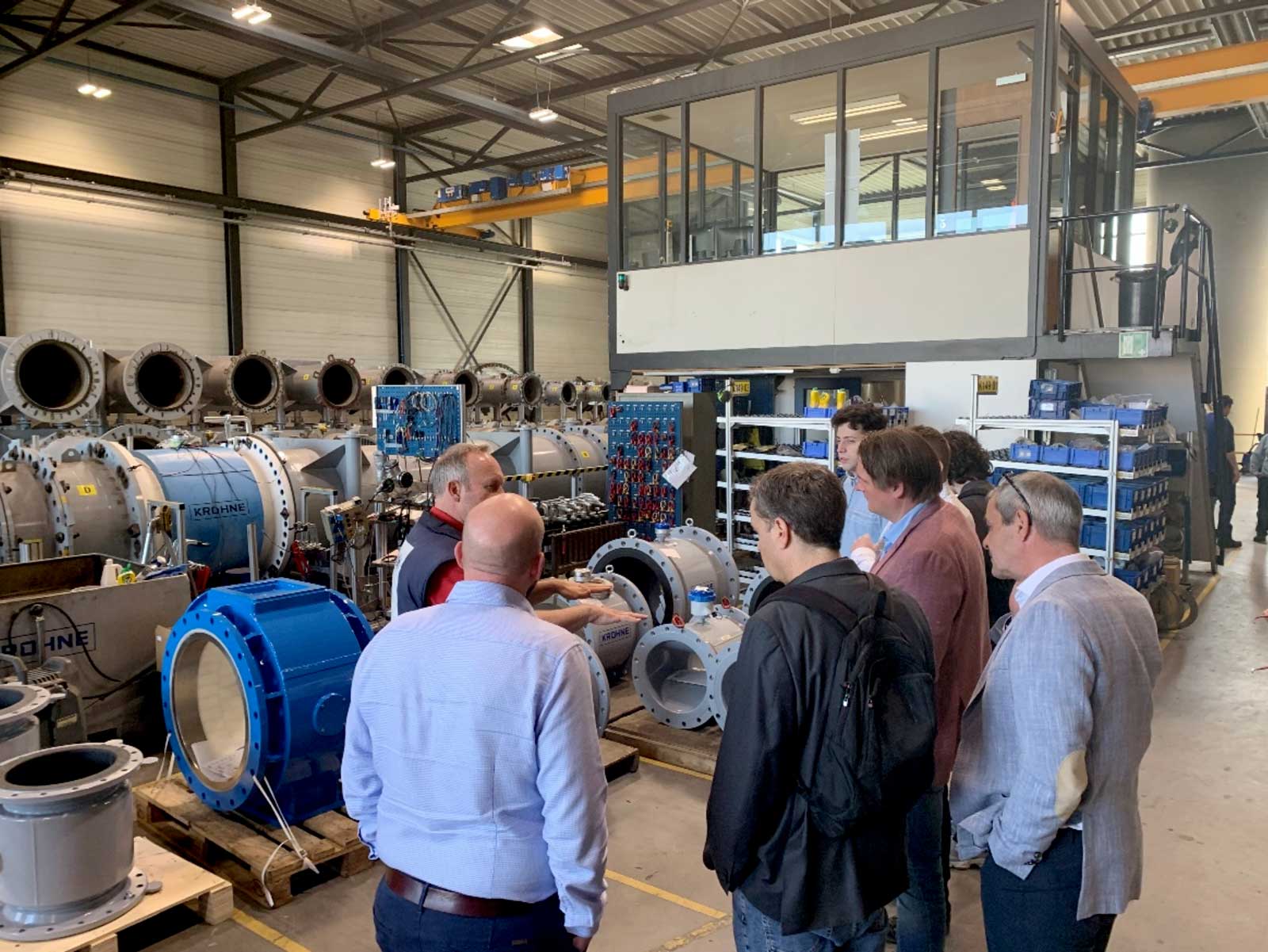
On Thursday 19/3 we had the pleasure of visiting the Krohne facilities in Dordrecht as part of a joint event organized by TechBinder and Ecosystem Services. The day started with an impressive introduction to Krohne by Jan Kees Hoogendoorn – vice president Innovation Flow Division.
KROHNE is a global manufacturer of industrial process instrumentation, specializing in flow, level, temperature, and pressure measurement solutions. The company serves industries such as water, energy, maritime, chemicals, and oil & gas with innovative and reliable measurement technologies. Applications in the maritime sector are close to the PRIMMA domain, such as dredging and shipbuilding. With 700 employees in Dordrecht alone, Krohne is a large supplier to the global maritime and industrial sector.
Rutger Tromp – technical lead innovation – took over with a highly inspiring presentation on Krohne’s vision for digital twins with the title “measure the facts”. Building up data and knowledge takes time, which makes it all the more impressive that Krohne has already made such significant steps in this field. Rutger elaborated on digital twinning as means for IT-OT integration and the role of IIoT (industrial Internet of Things) as part of the required digital infrastructure.
The visit was concluded with a tour at the production facilities showing flow solutions from mm’s width to an impressive 3 meter!
Throughout the morning, around 50 participants from different countries took part in the excursion to discuss digital applications and the most suitable connectivity setups to support them. For Krohne, connectivity – 5G or otherwise – is a prerequisite yet one that other domains are meant to deal with. After the visit to Krohne, the program continued at the Duurzaamheidsfabriek in Dordrecht — an inspiring place where companies collaborate and experiment with new digital solutions such as digital twins.
Afternoon: workshop and seminar on private mobile networks, use cases and QoS requirements.
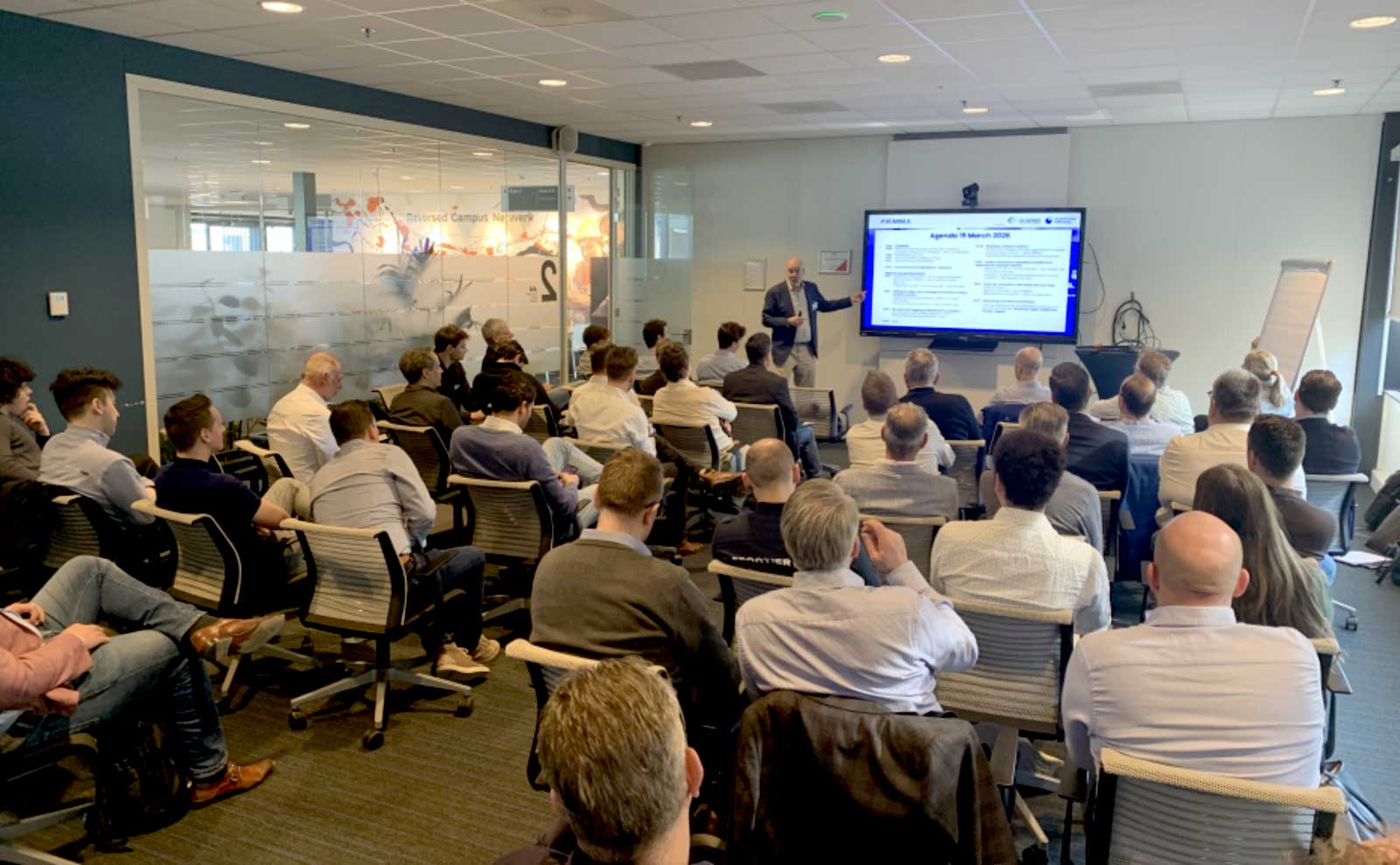
The afternoon programme was centred around use case for private networks and the KPI’s required to run designated applications. The programme had 2 ports cases with real deployments (ECT Rotterdam and Port Barcelona) and presentations from experts of LStelcom, Siemens and Viavi.
Mark and Koen reiterated the visit to Krohne of that morning, then articulated the essence of the PRIMMA programme. With some 3rd party statistical material they illustrated the growth of the niche, the verticals deploying it and the myriad of deployments already in ports and airports.
Port cases of 5G usage
ECT container terminal
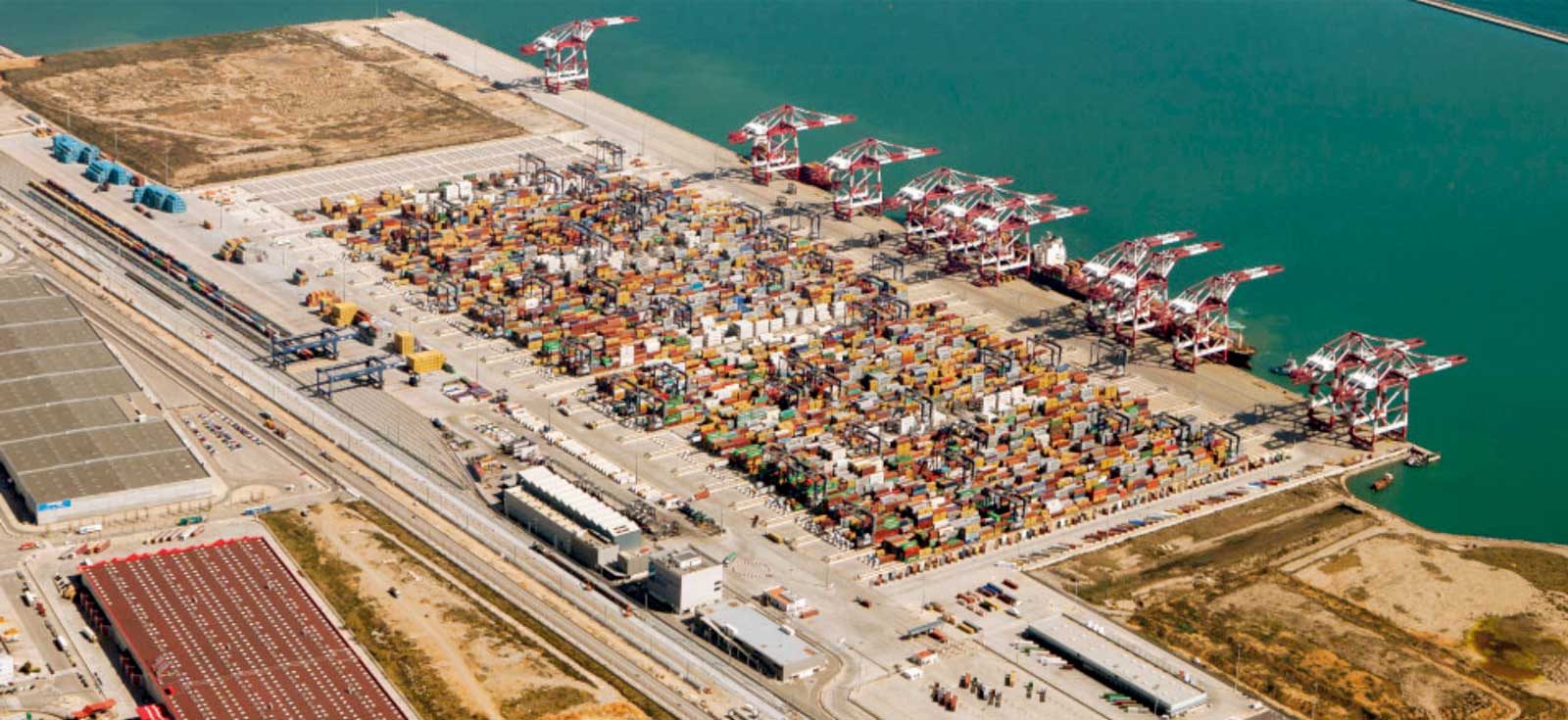
The container terminal of the port of Rotterdam presented its current private network and the ongoing transition to 5G. The presenter Hans van der Sluijs – has been their consultant for years and current project manager Ardin van Mourik also attended. ECT is one in a cluster of no less than 5 competing container terminals in port Rotterdam. ECT’s case is a compressive and very demanding one with 100’s of cranes and AGV’s steered and controlled over the network and fully automated stacking cranes and RTG’s on the network. Hans gave some insight in to the mobile network KPI’s required to run such demanding applications. The ECT container terminal is part of the Hutchison group, who is also the owner of the terminal in Barcelona (below).
Port of Barcelona
During MWC – 2 weeks prior to this seminar – a group of stakeholders visited port of Barcelona as an off site excursion related to MWC. There we were presented with the port’s innovation strategy and associated connectivity. This port has challenges in its proximity to the town and also has 2 container terminals. A lot of innovation goes into electrification, carbon footprint, marine life etc. Also this port embarked on a private 5G network for which they sourced the operations of Spanish MNO Orange. The port tendered and orchestrated the service yet does not operate it nor offers it to tenants; that Orange does. An interesting case of a port that did take a role in private 5G.
Barcelona BEST container terminal
The port houses an – again – Hutchison container terminal called BEST (Barcelona Europe South Terminal). This terminal does not yet have p5G then again does deploy the 5G Orange service the port authority contracted. Like ECT in Rotterdam this terminal deploys quai cranes, stacking cranes, AGV’s, RTG’s. They have a very young site, as a consequence many cranes have fibre in their power cable reel hence do not need 5G. Graham Wilde from the Hutchison group had indicated how the group already has multiple terminals and ports with p5G and potentially has 50+ more to come. The statistics he gathered supporting rapid growth in terminal automation and 5G were convincing.
Presenter Agustin Sanchez from BEST gave us some hints as to why he does not yet deploy an genuine private 5G network. These considerations were all of a very operational kind, such as crane operation interruptions for installing of new equipment (like 5G) and the extreme conditions imposed on equipment mounted of a port crane. His presentation as a kind of ‘eye opener’ for the attending suppliers.
Quality of Service block
LStelcom and Siemens on KPI’s
LStelcom is the global specialist in RF and spectrum management and supports many regulators and industries. Siemens is well known in industrial automation and has developed its own p5G solution to help its customers with p5G. They jointly act in the enterprises p5G domain. Siemens’ Daniel May presented the portfolio of Siemens developed 5G for plant automation and their experience with cranes and AGV’s. For the topic of the workshop, they also dwelled on KPI requirements.
Viavi on QoS assurance
Test and measurement specialists Viavi – Ilya Samokhin – presented their experience and portfolio for actually measuring the QoS a user is getting under his SLA. Without such assessment an SLA can be rather academic if you can’t ascertain hat KPI’s are reached. With a network of sensors and constant pinging Viavi can continuously monitor whether a signal is preset what its parameters are (throughput, Latency, uptime, etc) and whether these parameters meet SLA specs and/or operational demands. This is likely to become the next frontier in private 5G networks
Workshop on operational use and options for wireless coverage
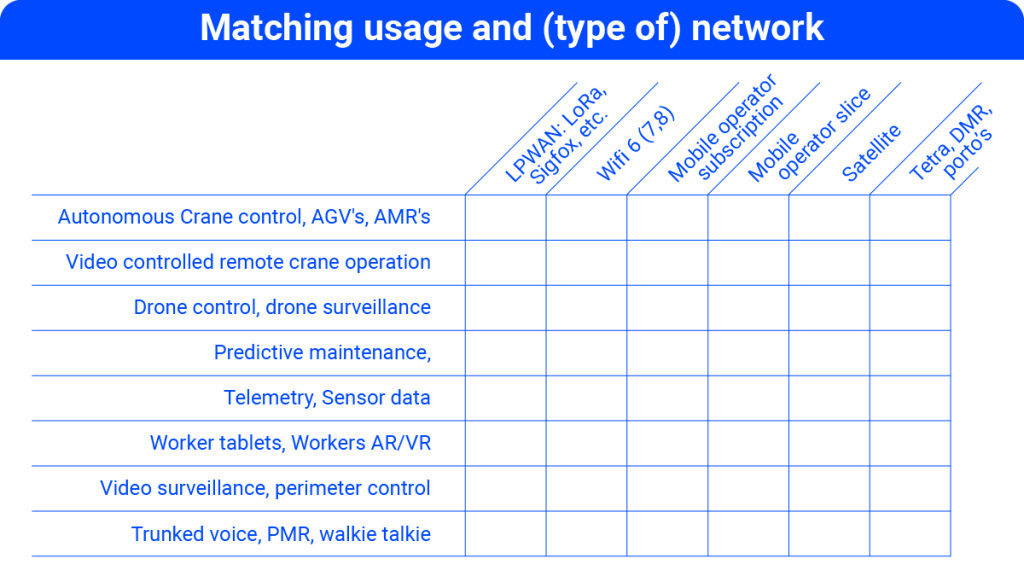
With all these presentations displayed, the group was then set to work (n subgroups of 10-12). At the hand of a matrix – see below – with resp. operational processes and network alternatives on the axis, groups were asked to ‘map’ how network alternatives meet or not meet the requirements of (ports) use cases of private 5G. The outcome was quite dispersed and is dealt with separately. A sound kick start of the KPI and QoS topic had thus been established.